


Maersk initiates nuclear-powered container ship project—yet commercialization remains far from straightforward
Source:
2026-09-04
Recently, nuclear-powered merchant ships have once again become a focal point of industry attention.
On September 2, Lloyd's Register (LR), Maersk, the Port of Charleston (USA), and the Port of Felixstowe (UK) jointly announced the establishment of "The Pink Corridor" partnership. The project will take a theoretical nuclear-powered container ship as its research object, identifying and assessing the operational, security, and safeguard requirements for such a vessel to navigate between the two ports. The focus areas include ship security, safeguard measures, cyber resilience, emergency response, insurance regimes, and the coordination between maritime regulatory frameworks and nuclear regulatory frameworks. The project is regarded as an important component of the exploration of civil maritime nuclear energy under the framework of the US-UK Technical Prosperity Agreement, and its findings are expected to inform the future establishment of a nuclear-powered shipping corridor between the two countries.
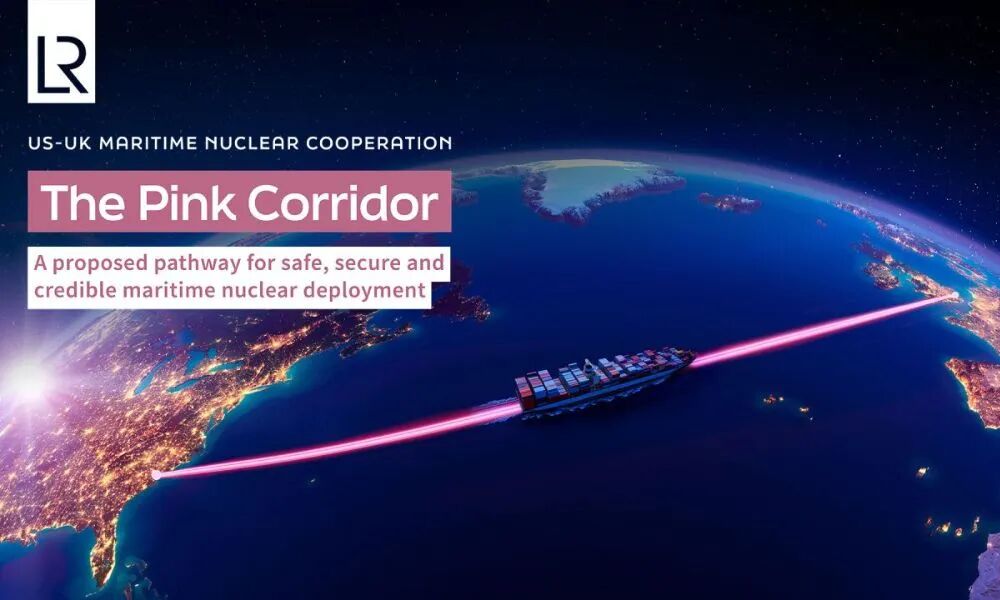
"The Pink Corridor" focuses on the practical operational requirements of a specific route. However, for nuclear-powered merchant ships to achieve true commercial operation, research from a single project is far from sufficient; systemic coordination at the level of international rules is even more necessary.
At the same time, the ATLAS (Applications of Atomic Technology for Licensing at Sea) initiative, launched by the International Atomic Energy Agency (IAEA), was officially inaugurated in Washington, D.C., aiming to formulate a development roadmap for floating nuclear power plants and nuclear-powered merchant ships. The IAEA and the International Maritime Organization (IMO) need to engage in substantive dialogue regarding the coordination of rules within their respective jurisdictions, clarifying the division of responsibilities to lay the groundwork for subsequent commercial feasibility assessments.
At the specific design level, since June 2026, three separate Approvals in Principle (AiP) have been granted to different concepts:
- Korean consortium design: A 15,000 TEU container ship concept jointly developed by the Korea Atomic Energy Research Institute (KAERI), the Korea Research Institute of Ships and Ocean Engineering (KRISO), and Samsung Heavy Industries, equipped with two molten salt reactors. It is part of the government-backed "K-Moonshot" research program, with development costs of approximately US$19.5 million.
- Pure car and truck carrier (PCTC) concept: Lloyd's Register granted AiP for a scheme based on Hyundai Glovis's 7,000 CEU design, adapted to accommodate a molten salt reactor. Project participants include HD Hyundai Heavy Industries, HD Korea Shipbuilding & Offshore Engineering, and KAERI.
- MIT Maritime Consortium reactor design: The American Bureau of Shipping (ABS) awarded AiP to the MIT Maritime Consortium for a design employing a near-atmospheric-pressure synthetic heat transfer fluid, enabling a thinner and lighter reactor vessel, with a designed thermal power output in the range of approximately 10 to 20 megawatts.
It should be clearly understood that an Approval in Principle (AiP) is a class society's preliminary confirmation of the technical feasibility of a conceptual design and does not constitute a construction permit or operational authorization. Lloyd's Register has also publicly stated that an AiP does not guarantee that the final design will obtain regulatory approval, nor does it signify full compliance with all applicable codes. For nuclear-powered vessels, this distinction is of particular importance—the current AiP assessments reference the IMO's 1981 Code of Safety for Nuclear Merchant Ships, which was formulated around pressurized water reactor technology and lacks specific guidance provisions for emerging designs such as molten salt reactors and small modular reactors. Moreover, the IMO has not yet confirmed a work plan for formally revising that Code.
No successful precedent for commercial nuclear-powered merchant shipping exists
The US "NS Savannah" (commissioned in 1962) operated for about a decade but failed commercially due to its far inferior cargo capacity compared to diesel-powered ships and excessive crew requirements. The West German "NS Otto Hahn" (1964–1979) experienced no major accidents but was always constrained by the cumbersome process of negotiating port access on a country-by-country basis. The Japanese "NS Mutsu" suffered a shielding failure during tests in 1974, triggering severe public protests, and was later converted to conventionally powered use. The Russian "Sevmorput" (commissioned in 1988) remains the world's only commercially operational nuclear-powered cargo vessel, but it too has historically encountered refusals of port entry. These cases demonstrate that public acceptance and the legal and political hurdles of port access are often more difficult to resolve than engineering issues.
The only currently binding international rule is Chapter VIII of the International Convention for the Safety of Life at Sea (SOLAS), which requires flag states and visiting states to conclude bilateral agreements but does not provide detailed safety standards. The 1981 IMO Safety Code has not undergone substantive revision since its adoption, and assessments by the World Nuclear Transport Institute have also pointed out that the Code lacks effective guidance for new reactor designs.
In the area of liability and compensation, the 1962 Convention on the Liability of Operators of Nuclear Ships has not yet entered into force, and the 1971 Convention relating to Civil Liability in the Field of Maritime Carriage of Nuclear Material applies only to the carriage of nuclear materials and does not cover a ship's own nuclear power plant. In this context, insurers and Protection & Indemnity (P&I) clubs can only negotiate underwriting arrangements on a case-by-case basis, which constitutes a major obstacle to the commercial deployment of nuclear-powered merchant ships.
Some countries have already begun drafting relevant regulations. The United Kingdom passed the Merchant Shipping (Nuclear Ships) Regulations in 2022, requiring any nuclear-powered vessel operating in UK waters to submit a safety assessment 12 months in advance. In the United States, the Nuclear Regulatory Commission (NRC) and the Coast Guard will share regulatory responsibilities, but the NRC has not yet issued specific guidance for modern commercial ship propulsion. Recently, the U.S. Maritime Administration signed a memorandum of cooperation with the Port of Long Beach, in conjunction with the Coast Guard, the Department of Energy, and others, to explore advanced nuclear technology applications. However, this agreement does not authorize any nuclear-powered vessels or establish new regulations.
Among classification societies, ABS published its Rules for Floating Nuclear Power Plants in 2024, which partially updates the 1981 IMO framework; the Russian Maritime Register of Shipping maintains the only currently active nuclear vessel rules in practice, but their application is limited to domestic pressurized water reactor vessels.
Hot News