


BYD: Over US$1 Billion to Buy 10 More Ships
Source:
2026-10-19
Recently, BYD Executive Vice President Li Ke (Stella Li) confirmed in an interview with 21News that the company has “bought another 10 ships.” The statement laid to rest earlier market speculation that BYD had placed additional orders for roll-on/roll-off (RoRo) car carriers, and once again brought “automakers building their own fleets” — a new trend in the shipping industry in recent years — into the spotlight.
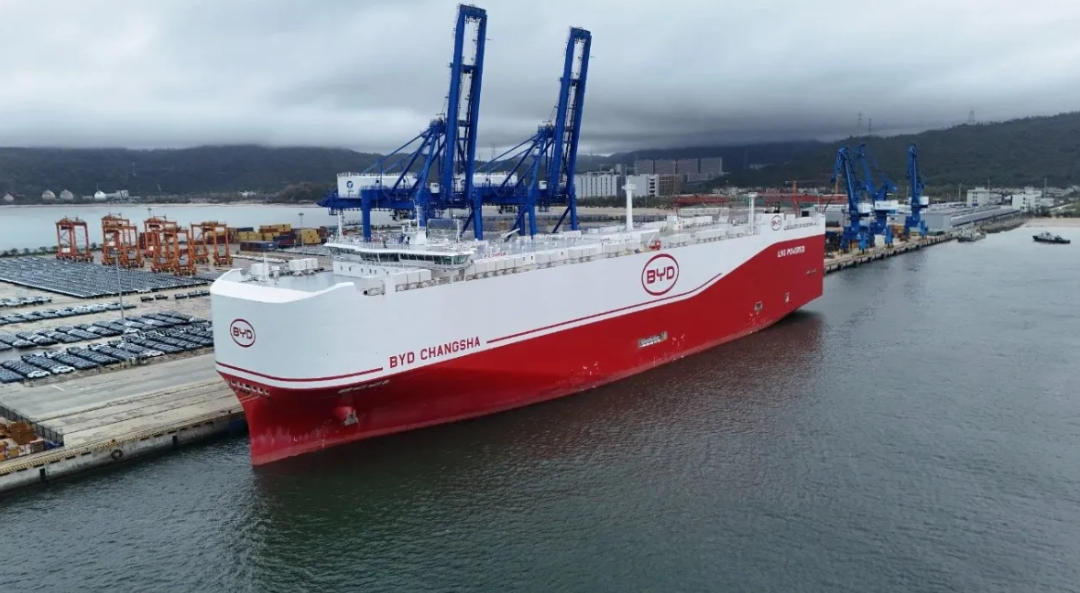
According to public reports, the 10 additional ships ordered by BYD are all large pure car and truck carriers (PCTCs), each capable of carrying more than 8,000 vehicles. They will use dual-fuel propulsion systems and are scheduled for delivery between 2029 and 2031. The total order value exceeds USD 1 billion, with each ship costing more than USD 100 million.
Li Ke said the additional vessels are intended to address tight market capacity and give the company greater control over transit times and deployment flexibility. Once the new ships are delivered, BYD’s owned fleet will expand from its current eight vessels to 18, with total capacity exceeding 130,000 CEU. For an automaker, this is no longer a “trial run” but a deep-sea RoRo fleet of considerable scale.
BYD’s plan to build its own fleet was not improvised. In 2022, BYD placed its first order for eight RoRo ships, with a total investment of about RMB 5 billion, and all of them were put into operation by September 2025 (see: All 8 Ships in Place! BYD’s “Maritime Fleet” with Million-Vehicle Capacity Is Complete). After the first eight ships entered service, BYD’s transport autonomy in overseas markets improved markedly. The additional order for 10 ships means its fleet planning has shifted from “securing basic capacity” to “supporting global expansion.” Given the delivery schedule from 2029 to 2031, the new ships will meet medium- and long-term transport demand after BYD’s overseas plants start production and regional markets scale up.
From an industry perspective, BYD’s case is a microcosm of the structural changes in shipping demand amid China’s automobile export wave. In the past, automotive RoRo transport was mainly handled by specialized RoRo shipping companies, with automakers acting as cargo owners. Today, more and more Chinese automakers are entering the capacity side through long-term chartering, joint ordering, and building their own fleets.
The news that BYD has ordered another 10 ships sends a clear signal: the global competition of Chinese automakers is extending from products going global and channels going global to logistics and supply chain infrastructure going global.
Hot News