


A 100-Ship Newbuilding Fleet Takes Shape! Yangzijiang Maritime Signs Order for 4+2 Bulk Carriers
Source:Beyond Shipping
2026-10-14
On October 12, Singapore-listed Yangzijiang Maritime Development finalized a bulk carrier newbuilding agreement in China, ordering four 82,000 dwt Kamsarmax bulk carriers from Jiangsu Huazi Energy Engineering Co., Ltd., with options for two additional vessels. This is Yangzijiang Maritime’s first order placed with Huazi Energy, and the second Kamsarmax bulk carrier construction contract won by the Qidong shipyard, following an order from a Xiamen shipowner.
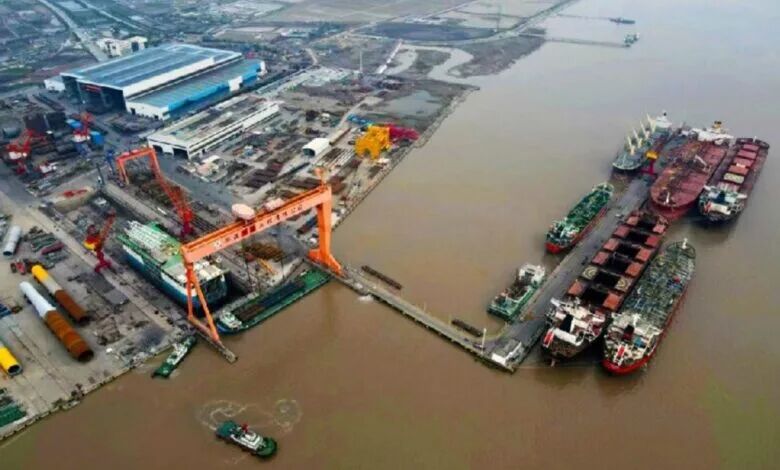
According to domestic shipbuilding industry sources, the base design for this order is an 82,000 dwt Kamsarmax bulk carrier. In August this year, Huazi Energy signed a contract with Xiamen Xiling Shipping (Amoysailing Maritime) for four Kamsarmaxes of the same type, scheduled for delivery in 2028. At the time, market estimates put the cost of a standard-configuration vessel of this type at US$35 million to US$38 million per vessel. The specific price of Yangzijiang Maritime’s current order has not been disclosed.
This new order is the latest move in Yangzijiang Maritime’s new round of diversified fleet expansion, independent of its previously announced Ultramax bulk carrier newbuilding plan. As early as September, Yangzijiang Maritime disclosed in one go 24 firm orders plus 16 option vessels, covering five major ship types, including six 64,500 dwt Ultramax bulk carriers, six MR product/chemical tankers, eight stainless steel chemical tankers and four VLCCs. At that time, its newbuilding asset pool totaled 98 vessels, comprising 75 firm newbuildings under construction, 16 option vessels, and another seven vessels already delivered. Adding this Kamsarmax order of up to six vessels, Yangzijiang Maritime’s newbuilding portfolio has officially surpassed 100 vessels.
In recent years, Yangzijiang Maritime has increasingly chosen domestic small and medium-sized shipyards to lock in newbuilding capacity, leveraging its own technical and supply-chain centralized procurement advantages to obtain more competitive ship prices. Its business model integrates newbuilding investment, time chartering, leasing and pre-delivery resale. It is also continuing to step up in the tanker segment; its project at Jiangsu Haifeng Shipbuilding now has confirmed orders for 6+2 114,000 dwt LR2 product tankers.
For Huazi Energy, this order marks its continued extension from marine supporting equipment manufacturing into traditional commercial ship final assembly and construction. Huazi Energy’s core business has focused on marine tanks for LNG, LCO2 and other applications, fuel gas supply systems, offshore engineering equipment and pressure vessel manufacturing, and it has long undertaken ship repair and modification work. In 2025, Huazi Energy delivered its first wind farm operation and maintenance vessel, taking its first step in complete-ship construction; it then won an order for four Kamsarmaxes from the Xiamen shipowner, formally entering bulk carrier construction. Huazi Energy had previously supplied Type B LNG fuel tanks to Yangzijiang Shipbuilding. This shift from component supply to complete-ship construction represents an important upgrade in the level of cooperation between the two parties.
In terms of fleet deployment strategy, Yangzijiang Maritime diversifies shipping-cycle risk through multiple ship types. The newly added Kamsarmaxes can carry a variety of cargoes such as grain, coal, iron ore, steel and fertilizers, reducing cargo and route concentration risk. Combined with the global phase-out of older, inefficient tonnage and environmental regulations raising the operating costs of older vessels, new-generation energy-efficient bulk carriers have long-term market opportunities. Its overall fleet layout spans VLCCs, LR2 tankers, chemical tankers and bulk carriers of different tonnages, forming a balanced asset portfolio.
Yangzijiang Maritime’s unique investment and operating model is the core reason it has been able to rapidly build a newbuilding asset pool of 100 vessels in a short period. The company works closely with second- and third-tier domestic shipyards, stationing technical teams at the yards for supervision, participating in equipment procurement and compressing construction costs. Its asset exit routes are flexible: it can resell vessels during construction to capture asset appreciation, or convert them into finance leasing or long-term time charters to lock in stable rental income. In the first half of 2026, 13 vessels had already secured one- to eight-year time charter contracts.
This latest Kamsarmax order from Yangzijiang Maritime is not merely a simple expansion of dry bulk capacity, but also the implementation of its asset allocation strategy. Relying on the capacity of domestic small and medium-sized shipyards, and with flexible resale and time charter exit channels, the company is simultaneously positioning itself across multiple tracks including dry bulk and oil/chemical tankers, using diversified ship types to hedge against cyclical fluctuations in any single shipping segment. For equipment supporting enterprises such as Huazi Energy, taking on complete bulk carrier construction represents a new trend of supporting enterprises in China’s shipbuilding supply chain extending upstream into final assembly. However, as it moves from supporting manufacturing to batch commercial ship construction, it will continue to face industry tests in construction performance, delivery schedules and quality control.
Hot News