


Another 12-Ship Mega Order Secured! Hengli Heavy Industries Ranks First Globally in VLCC Orderbook
Source:
2026-10-13
Recently, Hengli Heavy Industries signed construction agreements with several Greek shipowners for 12 tankers in a concentrated batch. The order covers 6 VLCCs (Very Large Crude Carriers), 2 Suezmax tankers, and 4 LR2 tankers. The average price per VLCC is nearly US$140 million.
VLCC Reaches a New Market Price High
The average per-vessel price of the VLCCs in this signing is nearly US$140 million, significantly higher than Clarksons' reference price for conventional-fuel VLCCs (about US$128–130 million), and also higher than Hengli Heavy Industries' previous conventional VLCC construction cost level of about US$119 million.
The most prominent price signal in the current VLCC market is that secondhand vessel prices have comprehensively surpassed newbuilding prices—a 5-year-old VLCC is valued at about US$143 million, already higher than the newbuilding price in this transaction; the resale price of a VLCC under construction is as high as US$172 million. This means that capacity that can be delivered immediately is worth far more than a new vessel that requires a three-year wait. Hengli Heavy Industries' ability to offer a relatively early delivery window (from 2028) is precisely the confidence behind its ability to secure orders at an average price of US$140 million.
Earlier market rumors have been confirmed by multiple market sources: the tanker "Pinios," delivered by Hengli Heavy Industries to Greek shipowner Dynacom Tankers Management in February 2026, has been resold to Dubai energy trader Onex DMCC for US$200 million. If the transaction is completed, this price will set the highest nominal transaction record in VLCC history—it is a 306,000 dwt VLCC built by Hengli Heavy Industries, sold only about seven months after delivery. Dynacom's purchase price for the newbuilding contract was about US$122 million; the resale spread this time reached about US$78 million, an asset value increase of about 64%, and the resale price in the secondhand market was nearly 1.5 times the VLCC newbuilding price at the time (when the VLCC newbuilding price was about US$131 million). This directly proves that its construction quality, design performance, and asset liquidity have won the highest market recognition: buyers are willing to pay a premium for the label "Built by Hengli Heavy Industries," fully confirming the extremely strong market recognition and asset premium capability of Hengli Heavy Industries' VLCC products.
Hengli's VLCC "New Oligopolist" Status Reconfirmed
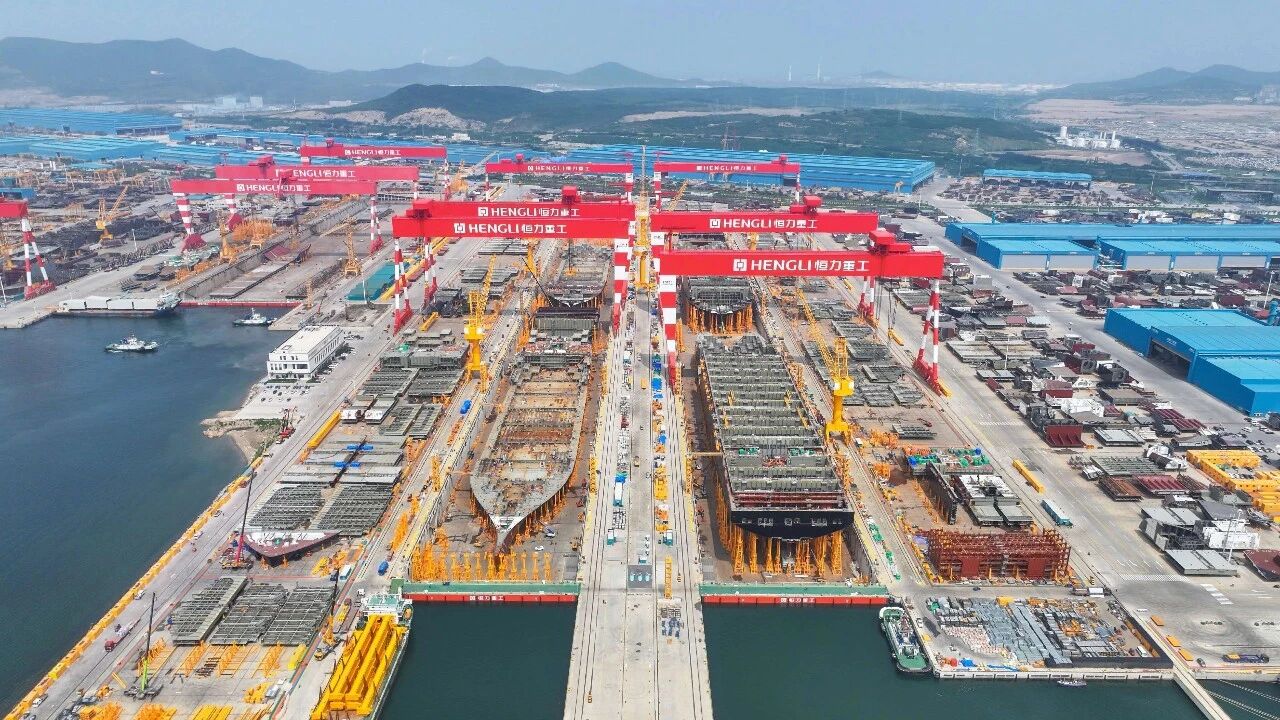
The ship types in this signing cover the main categories for deep-sea crude oil and refined product transportation. Among them, according to public statistics from Affinity, Hengli Heavy Industries' orderbook for just one ship type—VLCC—has reached 69 vessels, making it the shipyard with the largest number of VLCC construction orders in the world. It ranks first globally in orderbook volume for both VLCCs and Suezmax tankers. All three ship types use Hengli Heavy Industries' independent designs, aligning with the shipping industry's current development needs for renewing aging tonnage and advancing green, low-carbon transformation.
As of the end of July 2024, Hengli Heavy Industries had a total orderbook of 361 vessels, 61.67 million dwt, and 13.48 million CGT, ranking first among single shipyards worldwide by CGT. This includes 135 tankers, 113 bulk carriers, 105 container ships, and 12 VLACs, with delivery dates scheduled through 2030. Among them, according to statistics from UK shipbroker Simpson Spence Young, as of July 2026 the global VLCC orderbook had reached 306 vessels. The shipyard's VLCC orderbook was close to one-third of the global total, firmly ranking first among single shipyards worldwide and far ahead of second-place Hanwha Ocean. In the first quarter of 2026 alone, it took 54 orders, with customers covering top global shipowners such as Dynacom, Capital, and AET.
In Suezmax tankers, Hengli Heavy Industries signed a cumulative 20 vessels in 2026, all of independently designed ship types, and they have become one of its main construction types. Among them, following the landing of nine new orders from Hengli Heavy Industries, Dynacom's total Suezmax newbuilding order scale has risen to more than 30 vessels. Based on a global statistical scope that excludes shuttle tankers and includes this latest batch of new orders, the global Suezmax tanker orderbook at that time was about 141 vessels. Dynacom alone accounted for about one-fifth of the global orderbook in Suezmax newbuildings, making it the company with the largest holdings of Suezmax newbuilding orders among peers.
Dynacom's "Return to Order": The Most Weighty Credit Endorsement
In this order, the return of long-term partner Dynacom to place orders is particularly noteworthy, fully demonstrating the shipowner's continued recognition of Hengli Heavy Industries' construction quality and contract performance capabilities.
Since their first cooperation in 2023, Dynacom's orders with Hengli Heavy Industries have progressed from exploratory cooperation to repeat bulk purchases, climbing step by step along the technological ladder of "bulk carrier → VLCC → VLAC." As of the landing of this order, the cumulative number of new vessels built under their cooperation has exceeded 50, covering multiple ship types including VLCCs, VLACs, Suezmax tankers, and Kamsarmax bulk carriers. Among them, the total number of VLCCs cooperated on has reached 20.
On June 5, 2026, two 306,000-dwt VLCCs built by Hengli Heavy Industries for Greek shipping giant Dynacom, "EVROS" and "ACHELOOS," were named and delivered on the same day in Dalian, Liaoning. The same-day delivery of two giant vessels set a new record in the global shipbuilding industry, with each vessel delivered at least three months ahead of the contractual delivery date. After this delivery, Dynacom's orders placed with Hengli Heavy Industries for various bulk carriers and tankers exceeded 40, of which 17 have been delivered with high quality. At present, Hengli Heavy Industries' shipbuilding orderbook is scheduled through 2030, and its high-efficiency construction and high-level delivery capabilities have won recognition from international shipowners.
In the VLAC field, in July 2026, Greek shipping giant Dynacom ordered two 93,000-cubic-meter VLACs from Hengli Heavy Industries for the first time, at about US$115 million per vessel, with delivery expected in 2028. This not only marks its formal entry into the large liquid ammonia carrier market, but also represents the shipowner's first order for liquid ammonia carriers. Previously, its liquefied gas carrier business focused only on LNG carriers and was entirely undertaken by South Korean shipyards. Just two months later, Dynacom again added six VLAC orders to Hengli Heavy Industries. This add-on order and the July first order are together included in the eight-vessel newbuilding package worth nearly US$1 billion signed between Dynacom and Hengli Heavy Industries. This add-on also marks Dynacom's high recognition of Hengli Heavy Industries' VLAC construction capability, with their cooperation moving from first-order validation into the stage of repeat bulk orders.
Dynacom is the holder of the world's largest tanker orderbook. According to Clarksons statistics as of 2026, after adding Hudong-Zhonghua's 12 VLCC orders, Dynacom's fleet in service totals 68 vessels, and its orderbook of newbuildings has increased to 74 vessels, covering VLCCs, Suezmax, Aframax, and LR1 tankers. Its tonnage under construction is close to 15 million dwt, ranking first among global tanker owners in terms of newbuilding order scale. Its orderbook is highly concentrated in large crude carriers: the 74 newbuildings under construction include 34 VLCCs, 33 Suezmax crude tankers, and 11 product tankers. This structure clearly reflects Dynacom's strategic judgment—the long-distance trend in global crude oil trade is continuously amplifying transportation demand for large crude carriers.
The Chinese Shipyard Most Favored by Greek Shipowners
The cooperation between Dynacom and Hengli Heavy Industries has long surpassed an ordinary "supplier" relationship and entered the level of "strategic capacity partner." In the VLCC field, the first VLCC, "ALIAKMON I," was named and delivered in 2024; after entering 2026, Dynacom further expanded its VLCC orders with Hengli Heavy Industries. According to public industry reports, through additional orders, Dynacom increased its total VLCC orders at Hengli Heavy Industries to 16; combined with other related cooperation, the total scale has reached 20. As of 2026, four VLCCs of this type have been delivered with high quality, with excellent actual operating performance. This scale of cooperation is very rare in the international shipbuilding field and also reflects international shipowners' recognition of Hengli Heavy Industries' construction capabilities.
In terms of delivery performance, Hengli Heavy Industries has delivered two 306,000-dwt VLCCs and 13 Kamsarmax bulk carriers to Dynacom, with many vessels' construction progress ahead of contract milestones. After the vessels were put into operation, all performance indicators reached internationally advanced levels. This delivery result has also won recognition from shipowner Dynacom, driving the scope of subsequent cooperation between the two parties to gradually expand from single dry bulk carriers to crude oil carriers and large liquefied gas carriers, with cumulative cooperative orders exceeding 50. In a market environment where shipyard slots are extremely scarce and delivery time has become the primary decision variable, "early delivery" itself is a scarce capability.
From a broader perspective, according to statistics from authoritative shipping media TradeWinds and industry institution Clarksons, in the first half of 2026, Greek shipowners placed a total of 299 newbuilding orders, of which 235 were undertaken by Chinese shipyards, accounting for 79%; Hengli Heavy Industries alone accounted for 36% of Greek shipowners' Chinese orders. Greek shipowners control about one-fifth of the world's merchant shipping capacity, and their order flow has always been regarded by the international shipbuilding market as a bellwether. This data fully highlights the core competitiveness of Chinese shipyards in the global newbuilding market.
Since commencing operations three years ago, relying on a complete industrial chain, large-scale construction capacity, and stable delivery capability, Hengli Heavy Industries has received a cumulative total of 177 orders from Greek shipowners. These orders cover multiple ship types including bulk carriers, tankers, container ships, and very large liquefied gas carriers, with a total value of about US$10.2 billion (approximately RMB 69 billion). Hengli Heavy Industries has become the Chinese shipyard most favored by Greek shipowners.
At present, its Greek customers include top global oil shipping capitals such as Dynacom, Capital, Evalend, Thenamaris, and EUROBULK. Among them, Capital's and Evalend's previous gas carrier orders were almost entirely undertaken by South Korean shipyards. Now these two major capitals have collectively turned to Hengli Heavy Industries, marking that leading international oil shipping capital has formed systematic recognition of Chinese shipyards' technical capabilities and delivery flexibility, rather than an accidental case-by-case choice.
Independent Design: Hengli Heavy Industries' Secret to Winning Orders
In terms of technical strength, the VLCC, Suezmax, and LR2 ship types in this order all use Hengli Heavy Industries' independent designs. The core competitiveness of the three ship types is rooted in fully independent design capability—this enables Hengli Heavy Industries to rapidly iterate according to shipowner needs and achieve batch-based, takt-based construction:
VLCC: The independently developed 306,000-dwt ship type has an overall length of 332.8 meters, a molded breadth of 60 meters, and a service speed of 14.5 knots. Through drag-reducing hull lines and an energy-saving stern superstructure design, wind and wave resistance is reduced. For example, the 309,000-dwt VLCC "ASIAN PROGRESS VII" greatly reduced wave-making resistance during navigation by optimizing the bow line design, effectively improving propulsion performance. From actual application results, the world's first methanol dual-fuel intelligent VLCC, "Kai Tuo," through such drag-reducing and energy-saving design combined with environmental protection equipment, can reduce carbon dioxide emissions by up to 92%, sulfur oxides by 99%, and particulate matter emissions by 90% compared with traditional fuel-powered vessels. The new-generation very large crude carriers delivered by China also achieve world-class performance indicators through such designs, with all performance and environmental indicators reaching industry-leading levels. Dynacom's willingness to continuously place batch orders for VLCCs, a core ship type, with Hengli Heavy Industries is the most direct recognition of its independent design capability.
Suezmax: New Times Shipbuilding won an order for 10 Suezmax crude tankers from Greek shipowner Dynacom. Together with previously accumulated orders for the same ship type, the large-scale clustering of 20 orders for the same type is a direct manifestation of the takt-based and batch production brought by independent design. Data from Clarksons Shipping Intelligence Network shows that currently more than half of the world's Suezmax tanker orders are being built at Chinese shipyards, among which Dynacom ranks first globally in the number of orders for this ship type. This order also marks that Chinese private shipbuilders have moved from "catching up" to "leading" in this ship type.
LR2: It adopts the latest green and environmentally friendly design concept, meets IMO Tier III emission standards, and combines low energy consumption, high safety, and excellent operational performance.
According to authoritative statistics from Clarksons, from 2024 to 2026 the global cumulative VLCC newbuilding orders totaled about 296 vessels, of which Hengli Heavy Industries undertook 82, accounting for about 28%. VLCC orders newly signed since 2026 alone accounted for about 36% of global VLCC orders in the same period; since September 2025, Hengli Heavy Industries has cumulatively won dozens of VLCC orders, demonstrating powerful globally leading influence in the VLCC sector. Its global leadership in VLCC and Suezmax tanker orderbooks is essentially the result of the combined effect of "independent design capability" and "full-chain green technology."
When a private shipyard established only four years ago can simultaneously win batch orders from Greek shipping magnate families, the Norwegian shipping king, and Dubai shipowners, the "irreplaceability" of Chinese shipyards in the global tanker and gas carrier construction market has already turned from a trend into reality. This order for 12 tankers is the latest testimony to this historic leap.
Hot News