


World's First 325,000 DWT Methanol Dual-Fuel Digital Intelligent Ore Carrier Named
Source:
2026-09-02
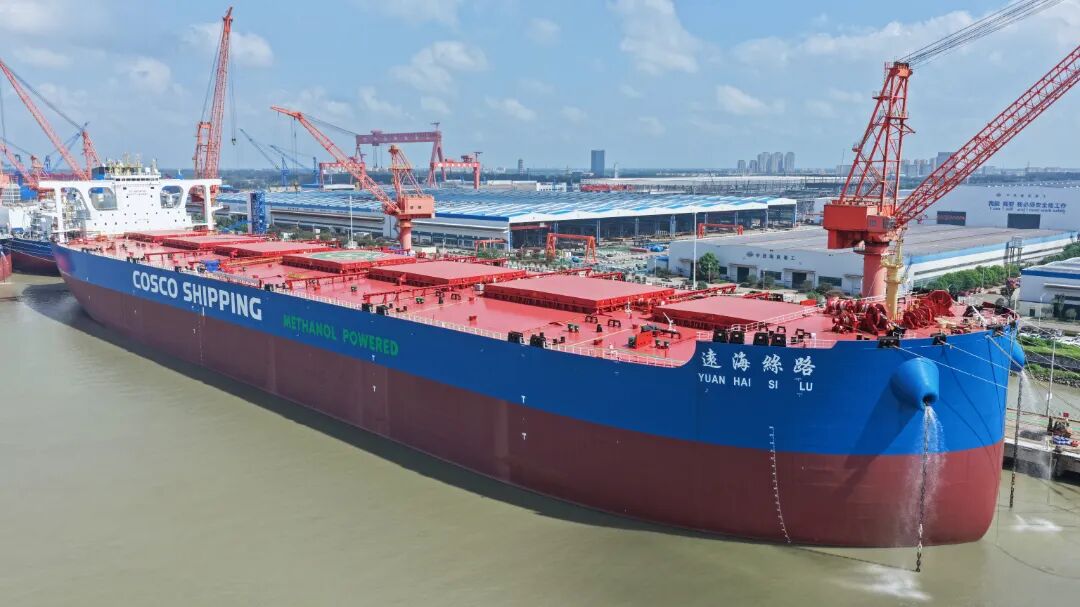
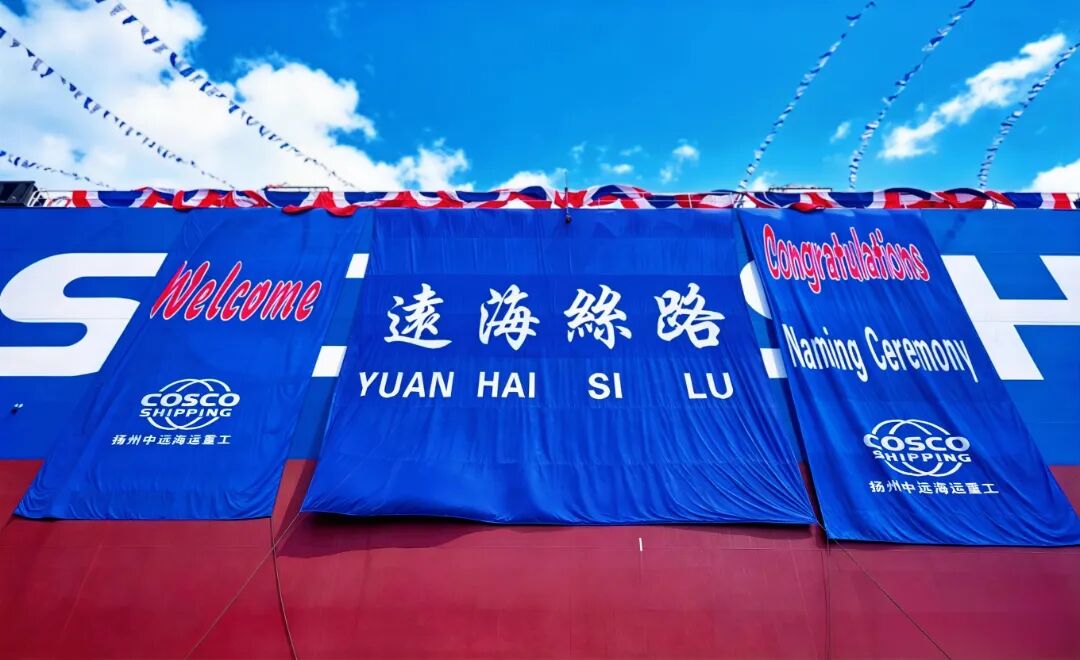
On the morning of September 1, the world’s first 325,000‑deadweight‑tonne methanol dual‑fuel ore carrier, built by COSCO SHIPPING Heavy Industry, to be operated by COSCO SHIPPING Bulk, and equipped with the world’s first shipborne digital delivery system, was officially named “YUAN HAI SI LU” in Yangzhou, Jiangsu Province. The completion and naming of this vessel mark significant breakthroughs for China’s shipbuilding industry in both green propulsion and digital delivery, offering a new “China Solution” for the green and intelligent transformation of the global shipping industry. It also provides safer, more reliable, and more sustainable transport capacity to ensure the stable and smooth operation of shipping routes for the global commodity industrial chain and supply chain.
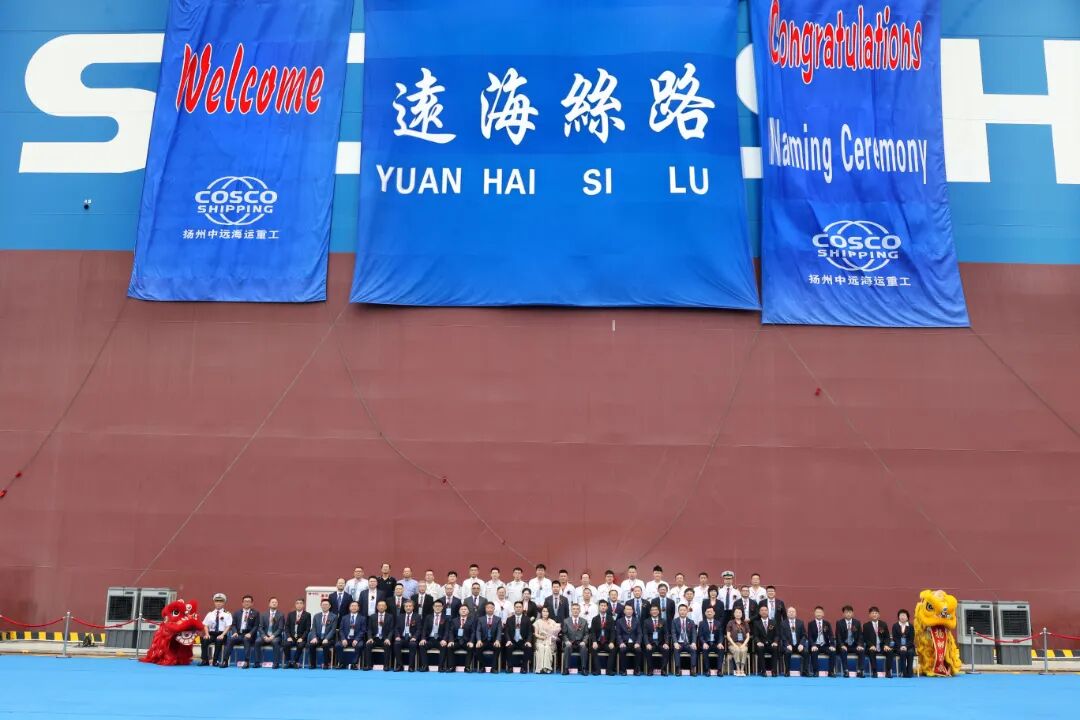
At the naming ceremony, Ms. Sun Li, wife of Mr. Huang Jian – one of the first batch of “National Outstanding Craftsmen” and Chief Designer at COSCO SHIPPING Heavy Industry – served as the godmother, performing the traditional bottle‑smashing christening to wish the vessel fair voyages.
Self‑Reliant R&D Breakthroughs Lay a Solid Foundation for Independent High‑End Ship Design
This giant vessel is jointly designed by COSCO SHIPPING Heavy Industry and the Shanghai Merchant Ship Design and Research Institute (SDARI). It has an overall length of 339.90 metres, a moulded breadth of 62.00 metres, a moulded depth of 30.00 metres, a structural draft of 21.25 metres, and a deadweight of 325,000 tonnes. The project has overcome several key technologies, including adaptivity technology for methanol fuel supply and auxiliary systems, key parameter research for vibration numerical simulation, and structural form and coating technology for methanol fuel tanks. Multiple energy‑saving and drag‑reduction schemes and modular construction processes have been applied for the first time in the industry.
In terms of intelligent shipping, the vessel meets the CCS i‑ship (N, M, E, I) smart ship notation and is additionally equipped with an integrated display and situational awareness system. This system integrates multi‑source data from the bridge, engine room, and navigation equipment, providing panoramic situational awareness, safety‑graded early warning, and intelligent decision‑support functions, thereby enhancing navigational safety. It also achieves the first open‑water autonomous navigation capability for a large domestic cargo vessel.
Special design features have been applied to the cargo hold area, increasing cargo capacity by more than 40% compared to conventional ore carriers of the same size. This allows the vessel to carry not only iron ore but also lower‑density bauxite, achieving full holds and full load. Based on years of research into the sailing routes and sea conditions for very large ore carriers (VLOCs), the vessel adopts a low‑wave‑added‑resistance hull form designed to withstand wind and waves in the mid‑to‑high latitudes of the Indian Ocean, resulting in an overall performance improvement of over 5%.
Regarding the choice to build this methanol dual‑fuel VLOC at the current time, a representative from the Science, Technology and Innovation Department of COSCO SHIPPING Bulk explained that under the “dual carbon” goals and the global consensus on climate change, emissions reduction has become an unavoidable requirement for the green transformation of shipping. COSCO SHIPPING Bulk is closely following the global wave of low‑carbon transition in shipping, proactively identifying market demands, and strategically deploying green capacity. Together with COSCO SHIPPING Heavy Industry, it is meticulously creating a new industry benchmark for the iterative upgrade of green and intelligent transport capacity, continuously enhancing its ability to serve the market and meet customer needs.
Green Methanol Power Creates a Benchmark Low‑Carbon Vessel
In terms of green power, the vessel meets the highest current International Maritime Organization (IMO) energy efficiency level – the Energy Efficiency Design Index (EEDI) Phase 3 standard. It is equipped with a methanol dual‑fuel main engine and boilers, allowing adjustment of the ratio of green methanol to conventional fuel to meet carbon emission targets at different operational stages. When operating on full green methanol, the vessel can reduce carbon dioxide emissions by approximately 52,000 tonnes per year, equivalent to planting 2.9 million trees, while almost completely eliminating sulphur oxide emissions and significantly reducing nitrogen oxide emissions. A single methanol bunkering gives the vessel a range of 20,000 nautical miles, roughly equivalent to sailing nearly one full circumference around the equator.
To address the strong corrosiveness of methanol fuel, the project team has overcome key coating technologies for methanol fuel tanks: the dedicated methanol tanks use inorganic zinc silicate coating, which utilises zinc dust as a sacrificial anode to form a physical barrier; the methanol/fuel oil combined tanks use polymer coatings, which polymerise to form a “protective film” with excellent penetration resistance. Both coating solutions ensure the safety and reliability of the fuel tanks throughout their full lifecycle.
Regarding the operational management of methanol fuel, the representative stated that COSCO SHIPPING Bulk has made comprehensive preparations at multiple levels in advance. Compared to traditional conventional fuel vessels, the management model for methanol vessels must shift from experience‑based management to a high‑standard “compliance + technology + emergency” integrated approach. Specific measures include: crew members must hold methanol special certificates and undergo specialised emergency drills for toxicity, leakage, fuel switching, etc., with personnel having been dispatched in advance to participate in engine manufacturer tests and sea trials; fuel switching requires double‑checking, gas detection, and pressure confirmation, while bunkering operations require a plan to be submitted 24 hours in advance and joint confirmation by the terminal, customs, and vessel parties; specialised equipment is in place for four types of scenarios (leakage, fire, poisoning, and system failure), with quarterly drills and annual ship‑shore joint exercises; and relying on high‑frequency sensor detection, corrosion‑resistant pipeline inspections, and ventilation linkage testing, a full‑lifecycle data platform has been established to enable intelligent early warning and 24‑hour monitoring.
Through training and team building, COSCO SHIPPING Bulk is cultivating a core group of skilled personnel on each vessel while simultaneously transforming its shore‑based teams, thereby building talent and management capabilities for the green and low‑carbon transition.
Pioneering Digital Delivery Ushers in a New Industry Era of “Delivering the Ship with Its Data”
The core technological breakthrough of this vessel lies in its adoption of a shipborne digital delivery system independently developed by COSCO SHIPPING Heavy Industry, achieving a historic leap from traditional “physical delivery” to “digital delivery” for ships. As one of the key implementation outcomes of the “Vessel” platform within COSCO SHIPPING Group’s “Cargo, Vessel, and People” trinity technology innovation system, this system effectively addresses the pain points of traditional ship delivery models, such as scattered as‑built documentation, coarse granularity, weak data correlation, and the high costs of post‑delivery data organisation for shipowners. The digital delivery system aboard “YUAN HAI SI LU” is a precise response to these challenges.
This system uses a 3D lightweight model as its core carrier to create a dynamic digital twin for the vessel’s entire lifecycle. It unifies data delivery standards and dynamically links key data, including equipment information, maintenance records, and spare parts data, thereby connecting the entire data chain from “design – procurement – manufacturing – delivery – maintenance”. Additionally, the system incorporates an AI‑powered multimodal intelligent retrieval module, enabling efficient search of vessel archives and in‑depth data analysis, providing data support for COSCO SHIPPING Bulk’s full‑lifecycle management of the vessel after delivery.
Thanks to its leading digital delivery technology, the project has secured two global authoritative certifications: On May 7 of this year, COSCO SHIPPING Heavy Industry (Yangzhou) was awarded the world’s first “Digital Delivery‑Based Conceptual Digital Ship” Approval in Principle (AiP) certificate, establishing a full‑chain digital pathway for vessels. On July 11, at the “China Maritime Day” Port and Shipping Enterprise Development Seminar, the China Classification Society (CCS) issued the world’s first General Design Approval (GDA) certificate for a shipborne digital delivery system to COSCO SHIPPING Heavy Industry, making it the first shipbuilder with 3D digital delivery capability. These progressive certifications – from concept to system – validate the compliance and feasibility of the digital delivery technology path and set a benchmark for the digital transformation of the global shipbuilding industry.
COSCO SHIPPING Bulk further revealed that the Group has clearly mandated that, in the future, 100% of vessels built by Group shipyards for Group shipping companies will achieve digital delivery.
Customer‑Centric Approach Drives Supply Chain Efficiency Improvement
“YUAN HAI SI LU” is scheduled for official delivery and operation in October of this year. The completion and commissioning of this vessel is a practical demonstration of COSCO SHIPPING Bulk’s commitment to a customer‑centric approach, providing customised and specialised integrated maritime logistics solutions to continuously create long‑term value for customers. Since the project’s inception, the company has deeply engaged with customer transport needs, rigorously aligning vessel selection and design phases with low‑carbon development goals by prioritising energy‑efficient and environmentally friendly designs – thereby embedding energy conservation and carbon reduction at the source. This provides customers with long‑term stable, cost‑effective, efficient, and green ocean shipping services. Concurrently, COSCO SHIPPING Bulk has integrated a full‑lifecycle lean management philosophy throughout the vessel’s design, construction, operation, and maintenance phases, establishing a comprehensive management system covering dimensions such as safety control, technical performance, and operational support. The goal is to create a replicable and scalable benchmark for the standardised, digitalised, and intelligent management of future newbuildings, thereby comprehensively enhancing long‑term operational management and integrated service support capabilities.
As a customised large ore carrier developed through project collaboration, the vessel’s entry into service will further strengthen the company’s cross‑ocean shipping corridor capacity, fill the gap in high‑quality transport capacity for long‑distance iron ore shipments, hedge against external risks such as freight rate volatility and supply changes in the international shipping market, continuously consolidate the transport foundation for critical mineral resources, and facilitate efficient, coordinated operation of upstream and downstream industrial chains.
With the successive commissioning of a new generation of green and intelligent vessels like “YUAN HAI SI LU,” COSCO SHIPPING Bulk will leverage green, low‑carbon, and digital intelligence as dual drivers. It will continue to optimise its fleet structure, iteratively upgrade its integrated logistics services, and resolutely ensure the stable and smooth operation of key commodity supply chains – particularly for iron ore. In doing so, it will contribute the strength of shipping to BRICS economic and trade cooperation and the high‑quality development of the Belt and Road Initiative.
Hot News