


$1.6 Billion Mega Order: HMM Locks In 12 Container Ships in One Go
Source:
2026-10-19
South Korea’s HMM said in a regulatory disclosure that its board has approved a container ship investment plan of about $1.617 billion, involving 12 vessels and adding a total of 114,100 TEU of capacity.
The plan includes ordering eight 13,000 TEU newbuildings and acquiring four resale newbuildings—three 2,800 TEU and one 1,700 TEU. The resale vessels were originally ordered by another shipowner and transferred before delivery.
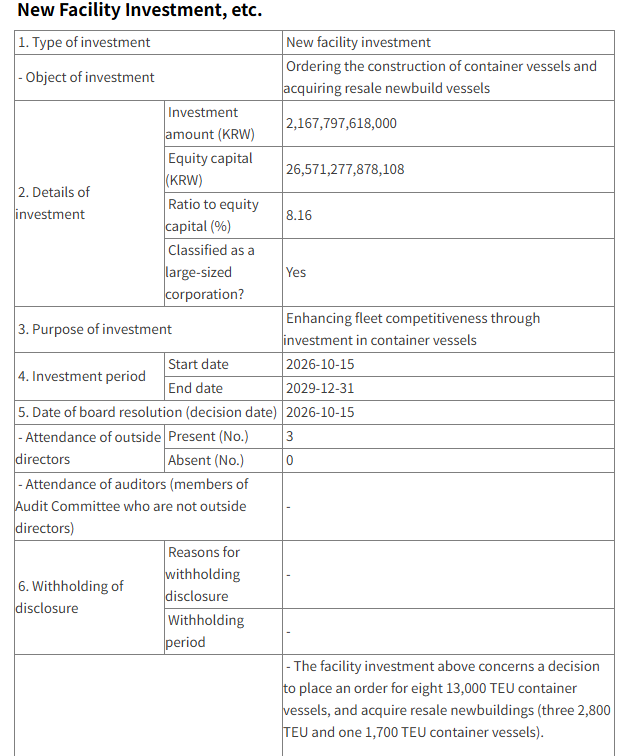
HMM said the total vessel price is $1,617,156,000, accounting for 8.16% of the company’s consolidated equity at the end of its most recent fiscal year; the amount may be adjusted according to detailed vessel specifications. The company did not disclose the shipyard for the eight newbuildings or the seller of the four resale newbuildings under construction. The investment period runs through Dec. 31, 2029, and final vessel deliveries are expected to be completed in December 2029, but may change with delivery schedules.
Previously, HMM ordered 12 13,000 TEU container ships at the end of 2025. At that time, HD Hyundai was designated to build eight of them, while Hanwha Ocean won the contract for the remaining four. These ships are scheduled to join the fleet from the second half of 2028 to the first half of 2029.
According to Alphaliner data, HMM ranks eighth among the world’s top 100 liner companies, with a 3% market share. In the first half of 2026, HMM operated 97 container ships with total capacity of about 1.02 million TEU and had an orderbook of 36 ships. In March, HMM was also linked to an order with HD Hyundai for 10 2,800 TEU ships. In addition to container ships, HMM is investing in other vessel types. In June, the company announced orders for eight bulk carriers and two very large gas carriers (VLGCs).
The revised strategic target approved by HMM’s board on July 24 is to have 166 container ships and 1.47 million TEU of capacity by the end of 2030, as part of a KRW 29 trillion ($22 billion) investment plan. The revised plan is centered on building a hub-and-spoke network, with large vessels operating on ocean routes and small and medium-sized vessels connecting origins and destinations through hubs. It replaces the 2024 strategy, which had targeted 130 container ships and 1.55 million TEU by 2030.
Hot News