


Listed Shipowner Accelerates Liquidation, Sells 51 Bulk Carriers for $840 Million
Source:
2026-07-20
Taylor Maritime is rapidly advancing its liquidation process, with its fleet having shrunk from a peak of over 50 vessels to just five remaining ships.
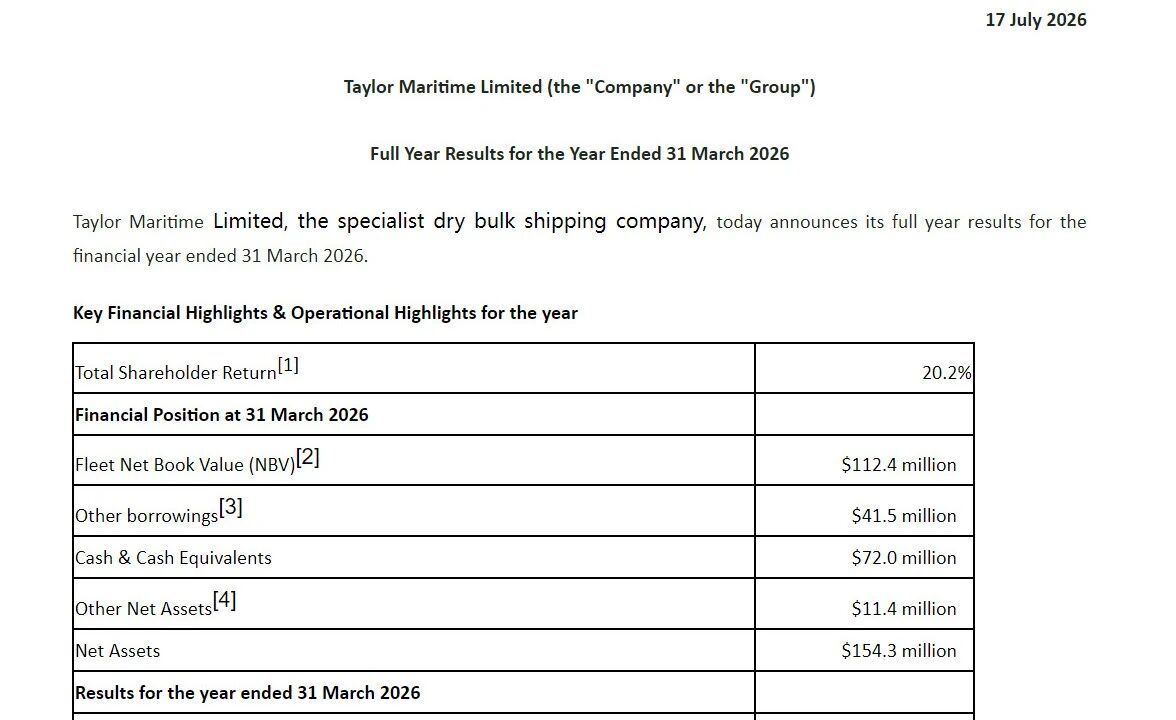
According to its latest financial report, between the start of 2023 and March 31, 2026, the company sold a cumulative total of 51 vessels, realising aggregate proceeds of US$839.2 million, at an average discount of 3.2% to fair market value. Of this, 23 transactions were completed in the last twelve months alone, generating US$381.1 million in proceeds at a narrower discount of 2.8%.
As of the reporting date, the company's fleet comprised six Japanese-built vessels, one vessel held through a joint venture, and one vessel on a long-term time charter. After the reporting period, the company sold one further Japanese-built vessel and transferred its 50% stake in the joint venture. The remaining five vessels—four Handysize and one Ultramax—are all currently trading on time charters. The company disclosed in its financial report that it has received offers for five of the six remaining vessels and for the joint venture stake, with the sale of one vessel and the JV stake subsequently completed after the period end.
In terms of financial performance, Taylor Maritime recorded a full-year loss of US$46.1 million, of which $23.7 million was attributable to impairment provisions on vessels either sold or classified as held for sale. As the asset realisation has progressed, the company has fully repaid its bank borrowings, leaving only $41.5 million in sale-and-leaseback liabilities. Once the previously announced mandatory partial redemption is completed, a total of $218.4 million will be returned to shareholders, bringing total distributions since the IPO to over $362 million.
Chairman Henry Strutt stated in the annual report that the shipping industry has experienced rare geopolitical and economic shocks over the past five years, and that the Board believes "decisively realising assets, supported by a strong balance sheet, is the most prudent course of action and in the best interests of all shareholders." CEO Edward Buttery further noted that the market is witnessing a significant disconnect between asset prices and fundamentals—"second-hand vessel values have climbed to historic highs, yet are out of step with current charter rates; meanwhile, global fleet deliveries are accelerating, with clear supply-side pressure ahead, meaning the risk-return profile of holding assets has markedly deteriorated. Coupled with the potential for sustained disruption from protectionist trade policies, we accelerated our divestments and repaid all bank debt in July 2025, prioritising the preservation of shareholder value."
Industry analysts observe that Taylor Maritime's proactive liquidation strategy reflects the complex decision-making environment currently facing small and medium-sized dry bulk owners: caught between elevated asset prices and expectations of future overcapacity, timing an exit to lock in returns is becoming a practical choice for some specialist shipowners. As the remaining five time-chartered vessels are subsequently disposed of, the company will complete its transition from a scaled operator to a pure capital allocator.
Hot News