


11 Ships in One Week! Hengli Heavy Industries' VLAC Orders Explode
Source:
2026-10-13
Recently, Hengli Heavy Industries achieved a major breakthrough in the cryogenic gas carrier sector, securing 11 VLAC (Very Large Ammonia Carrier) construction contracts in a single week. Hengli Heavy Industries had already risen to first place globally in VLAC order backlog. With these 11 additional VLAC orders won in one week, its top position has become even more secure.
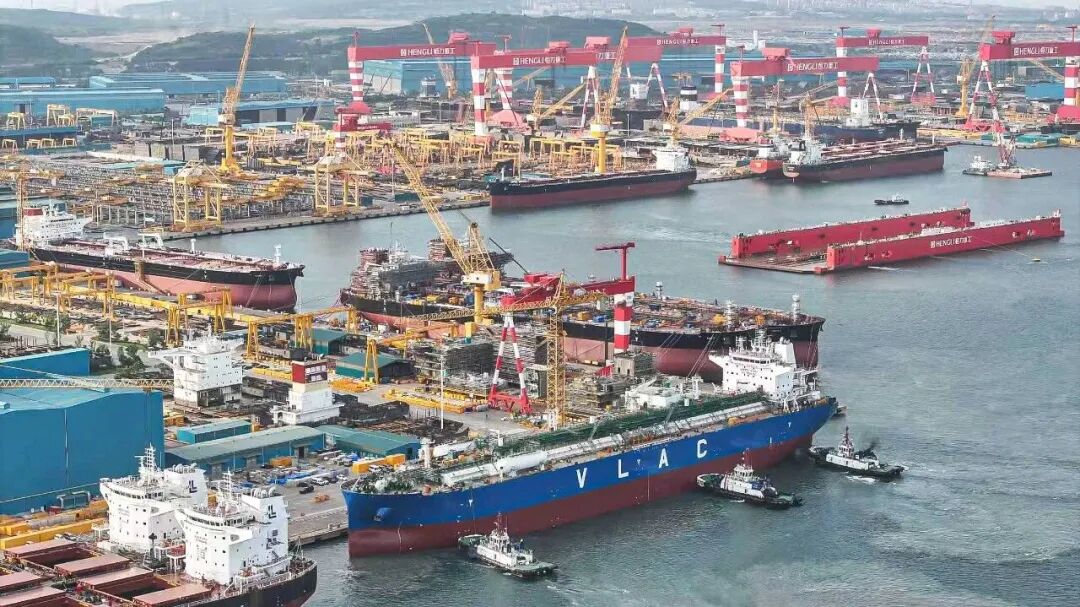
Order Scale: One Week Secures a Quarter of Annual Global Demand
The 11 VLACs signed in this concentrated batch cover three main specifications: 88,000 cubic meters, 90,000 cubic meters, and 93,000 cubic meters.
Notably, in the first seven months of 2026, publicly disclosed global VLAC orders totaled about 40 vessels. Hengli Heavy Industries’ signings within one week alone account for more than one quarter of annual global demand. In a niche market with total capacity of only 40–60 vessels, such a high concentration in a single week is extremely rare in global shipbuilding history.
Topping the global rankings by VLAC order backlog marks a major leap for Hengli Heavy Industries in the cryogenic vessel segment—from a “first-order breakthrough” to “scale-driven leadership.”
Technological Breakthrough: In-House Supporting Capabilities Connect the Entire Cryogenic Liquid Cargo System Chain
The core support behind this batch of orders is Hengli Heavy Industries’ full-chain in-house supporting capability in core equipment for cryogenic liquid cargo systems. Relying on its in-house supporting capabilities for Type A cargo tanks, dual-fuel main engines, and generators, Hengli has opened up the implementation chain for core equipment in cryogenic liquid cargo systems, translating technological reserves into real market competitiveness.
In-house production of Type A cargo tanks.Type A cargo tanks are the core component for storing liquid ammonia on VLACs. They must maintain sealing integrity and structural strength over long periods at -33°C, representing an extremely high technical threshold. Hengli Heavy Industries has achieved fully in-house manufacturing of Type A cargo tanks, freeing itself from dependence on a handful of overseas suppliers at the core-component level and creating differentiated advantages in construction cycle, project cost, and safety performance under liquid ammonia transport conditions.
Self-developed LPG dual-fuel engines. This series of vessels is equipped with LPG dual-fuel engines independently developed and manufactured by Hengli Heavy Industries, achieving full-chain in-house support from cargo tanks to the propulsion system. In-house engine production eliminates the “waiting for engines and idling” bottleneck—most shipyards worldwide rely on externally procured main engines, with lead times of 12–18 months, while Hengli Heavy Industries can control its own pace. At the same time, during operation, the vessel can use part of the liquid cargo it carries as fuel, creating an operational closed loop in which “the cargo transported is the fuel reserve.”
**In-house generator support is equally critical.** The ship power station is the vessel’s “pacemaker,” supplying electricity to the entire ship. Under liquid ammonia transport conditions, generators must adapt to vessel motion, the cryogenic environment, and the special power demands of the liquid cargo system. In-house support ensures the reliability and compatibility of the power system.
Together, these three technological breakthroughs constitute Hengli Heavy Industries’ differentiated competitiveness in the VLAC field: compared with the traditional model, in-house support makes the construction cycle controllable, project costs optimized, and cryogenic containment and safe operation and maintenance performance under liquid ammonia transport conditions uniformly guaranteed.
Strategic Significance: Claiming a Shipyard Seat in the Ammonia Fuel Era
As global shipping accelerates its low-carbon transition, demand for VLACs continues to rise, with liquid ammonia as a zero-carbon fuel. The International Energy Agency (IEA) forecasts that ammonia fuel’s share in shipping will rise sharply from 8% in 2030 to 46% in 2050. DNV expects that by 2050, seaborne ammonia trade could reach about 120 million tonnes per year, approaching the scale of today’s LPG trade, at which point about 200 VLACs will be needed to handle growing seaborne ammonia demand.
Ammonia contains no carbon and, when fully combusted, produces only water and nitrogen, making it a natural zero-carbon fuel. It is also an efficient hydrogen carrier that can bypass the technical bottlenecks of ultra-low-temperature liquid hydrogen storage and transport, releasing hydrogen at the destination through catalytic cracking. VLACs are not only ships that transport ammonia but also key infrastructure for the future hydrogen energy supply chain.
The successful signing of this batch of orders further consolidates Hengli Heavy Industries’ market position in the cryogenic vessel field, helping the company seize opportunities in clean-energy shipping and continue to expand the high-end offshore engineering and green ship markets. Leveraging the capacity advantages of its large dry docks, Hengli Heavy Industries has quickly entered the green shipping track and continues to strengthen its gas carrier product matrix. From VLACs to VLGCs and then to LNG carriers, Hengli Heavy Industries’ gas carrier product matrix is moving from a “single vessel type breakthrough” to “full-spectrum coverage.”
Hot News